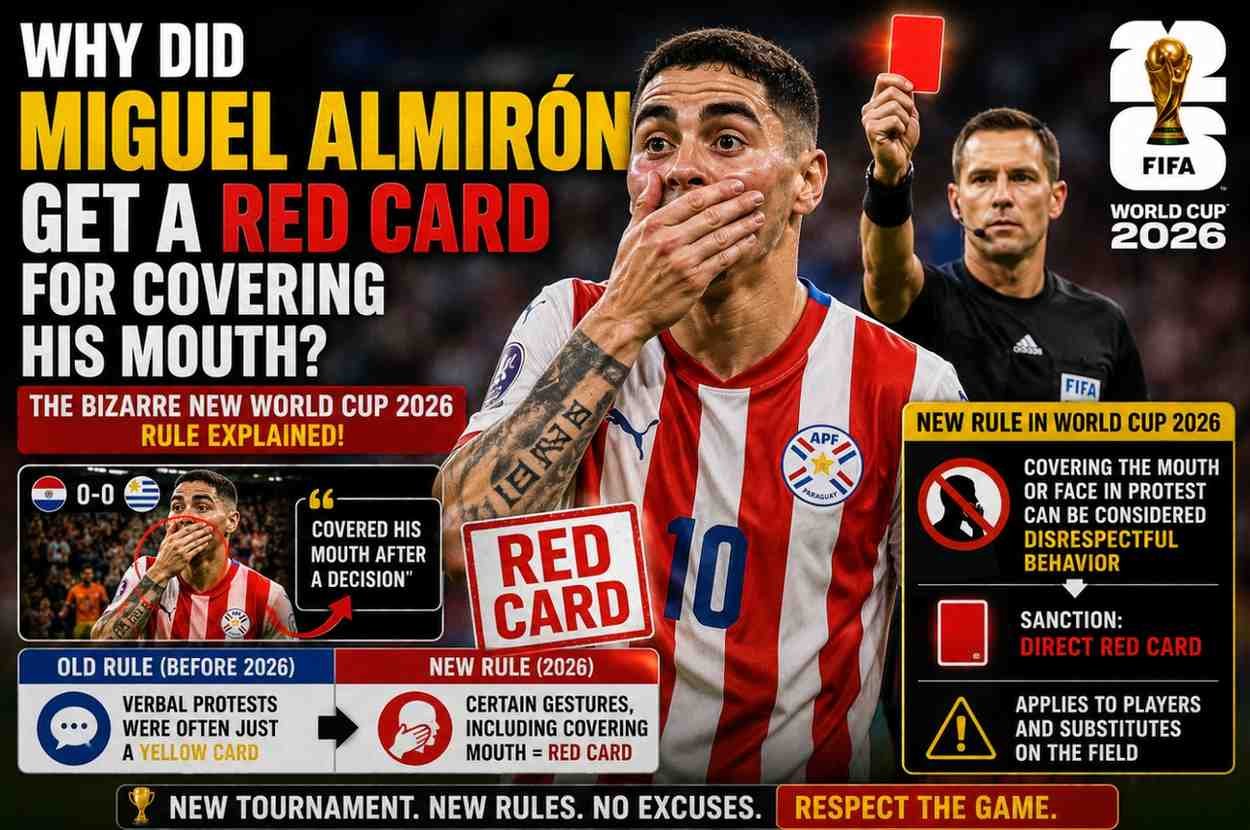
Paraguay midfielder Miguel Almirón just made World Cup history for the strangest possible reason: he became the first player ever sent off at a World Cup for covering his mouth while talking. If that sounds confusing, you’re not alone — here’s exactly what happened, and why this rule exists in the first place.
What Actually Happened
During first-half stoppage time in Paraguay’s Group D match against Türkiye, Almirón got into a heated exchange with Turkish defender Mert Müldür following a foul near midfield. As words were exchanged, Almirón raised his hand to cover his mouth while speaking — a gesture clearly aimed at stopping cameras and lip-readers from picking up what he said.
Müldür immediately appealed to the referee for punishment. After a video review, the official confirmed a straight red card. Paraguay, who were leading 1-0 at the time, were forced to play the rest of the match a man down — and still managed to hold on for the win, eliminating Türkiye from the tournament in the process.
Why Covering Your Mouth Is Now a Red Card Offense
This isn’t a referee making up a rule on the spot. It’s a genuinely new law introduced specifically for this World Cup by the International Football Association Board (IFAB), the body responsible for football’s official rulebook. Under the new regulation, any player who deliberately covers their mouth during a confrontational exchange with an opponent or official can be shown a straight red card.
The rule exists for one clear reason: to stop players from hiding insults, threats, or abusive language from referees, video review, and broadcast microphones. It was fast-tracked into the rulebook after a high-profile incident in European club football, where a player was accused of covering his mouth to hide alleged racist language directed at an opponent during a Champions League match. Rather than wait years for a slow legislative process, officials pushed the change through in time for this tournament.
How Almirón’s Own Team Reacted
Paraguay head coach Gustavo Alfaro didn’t try to defend the gesture, but he was clearly uneasy about how strictly the rule was applied. “According to the law, if you cover your mouth you’re sent off,” Alfaro said after the match. “There’s nothing I can do about that… I fear we are too strict and football loses its essence. In football, there’s friction, fights, clashes.”
Alfaro also revealed that Almirón apologized to his teammates afterward, acknowledging the position his red card had put the team in for the rest of the match — and for Paraguay’s next fixture, since a red card carries an automatic one-match suspension.
Not Almirón’s First Run-In With the New Rules
This wasn’t even the first time video review had gone against Almirón at this World Cup. In Paraguay’s opening match against the United States, a yellow card initially shown to USMNT defender Tim Ream was overturned on review — and Almirón was booked instead, for diving. Two matches, two cards, both decided by video review under this year’s stricter disciplinary framework.
What This Means Going Forward
With the rule now enforced once on the biggest stage in football, expect players across the rest of the tournament to think twice before covering their mouths in the heat of an argument. Whether that leads to fewer ugly confrontations — or simply more players getting caught out by an unfamiliar law — is something the rest of this World Cup will likely reveal.
A one-goal lead, a heated exchange, and a single hand-to-mouth gesture were enough to get Miguel Almirón sent off and make history for all the wrong reasons. It’s a strange first for World Cup football, but with the rule explicitly designed to stop players hiding what they say on the pitch, it likely won’t be the last time we see a red card shown for exactly this reason before the tournament is over.